Baby Shower Shoes: What Actually Survives Three Hours of Standing

Quick Answer: For a three-hour shower, choose a block heel under 5cm, a wedge, or a structured flat with real arch support - and match the sole to the venue surface. Grass needs a wide base or a wedge, hard floors need cushioning, and a stiletto fails on both. The single biggest mistake is wearing new shoes, since most shower discomfort is a break-in problem rather than a style problem.
A shower runs longer than the invitation suggests, and almost all of it is standing, holding a drink, in a room without enough chairs. The shoe decision matters more here than at a seated dinner.

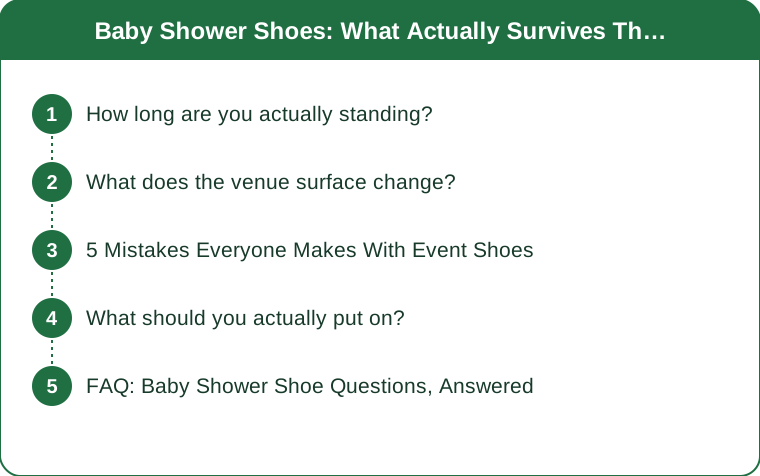
How long are you actually standing?
Longer than the schedule implies, and that’s the number to plan around.
A typical shower runs two and a half to four hours, and the structure is standing-heavy: arrival and mingling, games played standing, food served buffet-style, gifts opened while everyone gathers round. Seated time is often under 30 minutes total.
Add the parts nobody counts: the walk from parking or transport, standing to greet, and helping to clear up if you’re close to the host.
Why this matters for shoe choice: the discomfort curve for most shoes is not linear. A heel that’s fine for 45 minutes can become genuinely painful at 90, because that’s when the ball of the foot has accumulated enough load. Choose for hour three, not for the first hour - which is the opposite of how most people assess a shoe in a shop.
The practical test at home: put the shoes on and stand - not walk - for 20 minutes while doing something else. Standing still is harder on feet than walking, and it’s the test that matches the event.
What does the venue surface change?
It changes the answer entirely, and it’s the question people forget to ask.
Grass or garden - increasingly common for autumn showers:
- Wedges and block heels distribute weight and stay on the surface
- Stilettos sink, and there is no recovering from this once it starts
- Flats work, but choose a sole with some grip; damp autumn grass is slippery
- A wedge is the single best grass shoe - height without sinking
Hard floors - restaurant, hall, tiled home:
- Cushioning matters most. A thin-soled flat on tile for three hours is genuinely uncomfortable, often more so than a well-cushioned low heel
- Look for some sole thickness or add a cushioned insole
Carpeted home:
- The most forgiving surface. Almost anything works
- Check whether it’s a shoes-off household - it often is, which makes the whole question moot and makes what you’re wearing on your feet underneath suddenly relevant
Mixed venue - indoor with garden access, which is very common:
- Default to a block heel or wedge. It’s the only category that handles both.

5 Mistakes Everyone Makes With Event Shoes
1. Wearing them new. The most common and most preventable. New shoes need at least two or three wears around the house before a three-hour event. Blisters at hour one change the entire day.
2. Choosing for the outfit photo rather than the event. Photos happen for about four minutes. Standing happens for three hours. A block heel photographs perfectly well.
3. Ignoring the arrival and departure walk. Parking, public transport, and a walk from the car in the rain all happen in the same shoes. If the walk is more than a few minutes, either the shoes need to handle it or you need a second pair in the bag.
4. Assuming flats are automatically comfortable. A completely flat, unstructured ballet flat with no arch support is one of the worst options for prolonged standing - it offers no support at all and many people find it harder than a low heel. This is the third mistake and it catches people who chose flats specifically to be sensible.
5. Skipping the socks question. Bare feet in leather for three hours produces friction exactly where you don’t want it. No-show socks or a strip of tape at known rub points cost nothing and solve most of it.
What should you actually put on?
Ranked for a three-hour standing event, best first.
1. A block heel, 3-5cm. The most reliable option overall. Enough height to feel dressed, a wide enough base to be stable, and the small heel actually reduces load on the ball of the foot compared to a completely flat shoe. Works on grass and hard floors.
2. A wedge. Best on grass, and the most comfortable heel type at any given height because the sole is continuous. Slightly less formal-looking, which suits most showers.
3. A structured flat with arch support. A loafer, a pointed flat with a shaped footbed, or a low ankle boot. The word doing the work is structured - it needs a real footbed, not a soft slipper construction.
4. A low ankle boot. Excellent for an autumn shower, works on any surface, and pairs with everything from a dress to trousers.
5. A clean, minimal sneaker. Genuinely acceptable at a casual daytime shower, and by far the most comfortable option. Read the invitation and the venue before choosing this.
What to leave at home: stilettos, anything with a thin ankle strap that cuts in, brand-new anything, and unstructured ballet flats.
A useful backup: a pair of foldable flats in the bag. It weighs almost nothing and turns a bad shoe decision into a non-event.
FAQ: Baby Shower Shoe Questions, Answered
Is it rude to change shoes partway through?
Not at all - people do it routinely at weddings, and a shower is far more casual. Changing in a bathroom rather than at the table is the only etiquette involved.
What if I’m pregnant myself?
Feet swell and your centre of gravity has shifted, so stability matters more than usual. A wedge or a supportive flat is the safest choice, and it’s worth going half a size up - pregnancy-related swelling is real and a shoe that fits in the morning may not by afternoon.
How do I deal with an autumn shower that’s outdoors?
A closed-toe block heel or ankle boot, plus tights. Damp grass is cold and slippery, and open toes on a garden lawn in October is the most common regret people report.
Do heel protectors for grass actually work?
The small caps that fit over a heel do help prevent sinking, and they’re inexpensive. They’re a reasonable fix if you’re committed to a particular pair - but a wedge solves the problem without any accessory.
TL;DR:
- Plan for three hours of standing, not for the first hour
- Match the sole to the surface: wedges and block heels for grass, cushioning for hard floors
- A 3-5cm block heel is the most reliable all-round choice
- Unstructured ballet flats are not the safe option people assume they are
- Never wear them new, and keep foldable flats in the bag as insurance
The shoes are the only part of a shower outfit that you’ll still be thinking about at hour three. Choose them for the standing, and the rest of the outfit gets to be about how it looks.
Keep Reading
This article is for general informational and styling purposes only. Fit, sizing, and product availability may vary.